


How to Get a US Driver License as an Immigrant (2026)
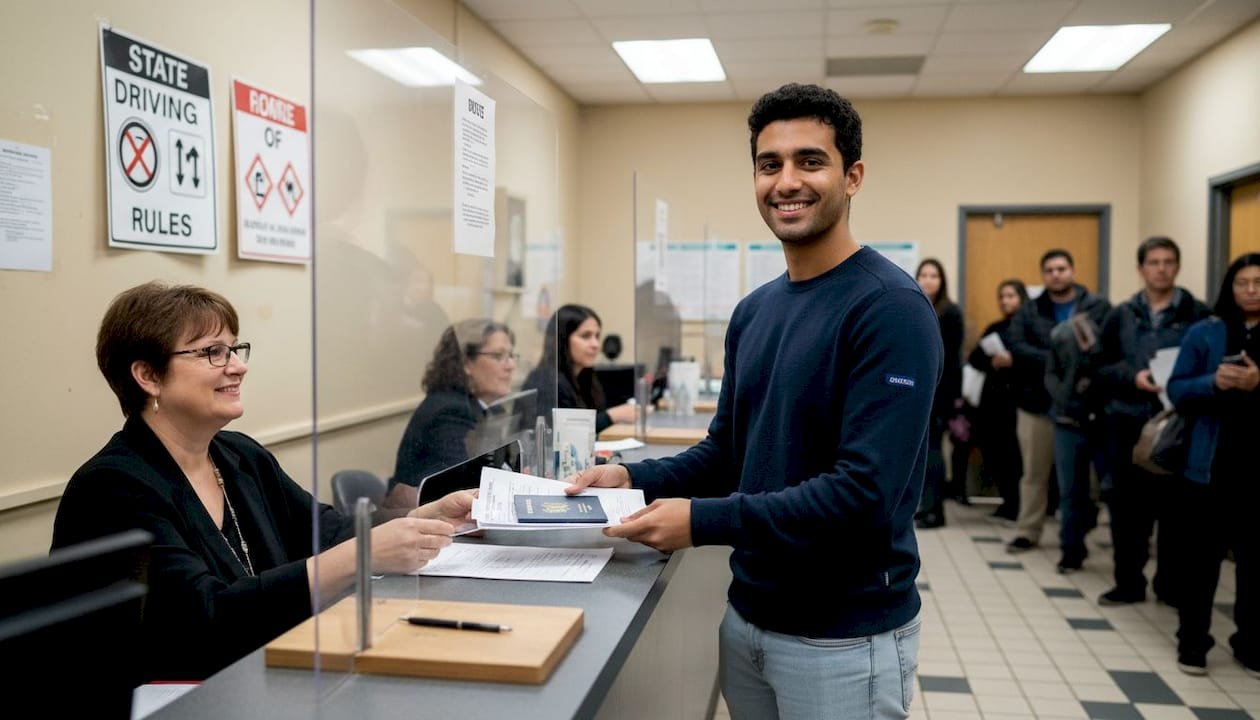
For many Russian-speaking immigrants, getting a US driver license feels like one of the most stressful bureaucratic tasks they face after arriving. The process involves multiple steps, unfamiliar terminology, and rules that differ from state to state. Without native-level English or prior experience with the American Department of Motor Vehicles (DMV), it is easy to feel lost. This guide breaks down every stage clearly, from gathering your documents to passing the road test, so you can approach the process with confidence and a realistic plan.
Table of Contents
- Understanding the requirements for a US driver license
- Step-by-step process to apply for your first US driver license
- Studying for the DMV written exam: best practices for Russian-speaking immigrants
- After the test: Receiving, renewing, or replacing your US driver license
- What Russian immigrants wish they knew before starting the US driver license process
- Get extra help for Russian-speaking immigrants
- Frequently asked questions
Key Takeaways
| Point | Details |
|---|---|
| Clear requirements | Each state has specific documents and eligibility criteria you must meet to get a US driver license. |
| Follow the steps | Begin by gathering documents, then complete the written, vision, and driving tests in order. |
| Prep with Russian resources | Russian-language study guides and tests greatly improve your chances of passing exams. |
| Stay up to date | Regularly check renewal, replacement, and name or status update rules to keep your license valid. |
Understanding the requirements for a US driver license
Before you visit any DMV office, you need to understand who qualifies and what documents you must bring. The good news is that most states welcome immigrants who are legally present in the country to apply for a driver license.
Eligibility basics
To apply, you generally need to meet three conditions:
- Be of minimum driving age (usually 16 or 17, depending on the state)
- Have legal presence in the United States (valid visa, green card, work permit, or similar)
- Be a resident of the state where you are applying
As noted in the full US driver license guide, DMV requirements vary by state but most require proof of identity, legal status, and residency. Always verify the exact rules for your state through official DMV information before making an appointment.
Key terms you should know
- DMV stands for Department of Motor Vehicles, the government agency that handles driver licenses and vehicle registration.
- A learner’s permit is a temporary document that allows you to practice driving with a licensed adult before taking your road test.
- Proof of residency means documents showing you live at a specific US address, such as a utility bill or rental agreement.
Documents checklist
| Document type | Examples |
|---|---|
| Proof of identity | Passport, foreign national ID |
| Legal presence | Visa, green card, work permit, I-94 |
| Social Security | Social Security card or SSA letter |
| Proof of residency | Utility bill, bank statement, rental agreement |
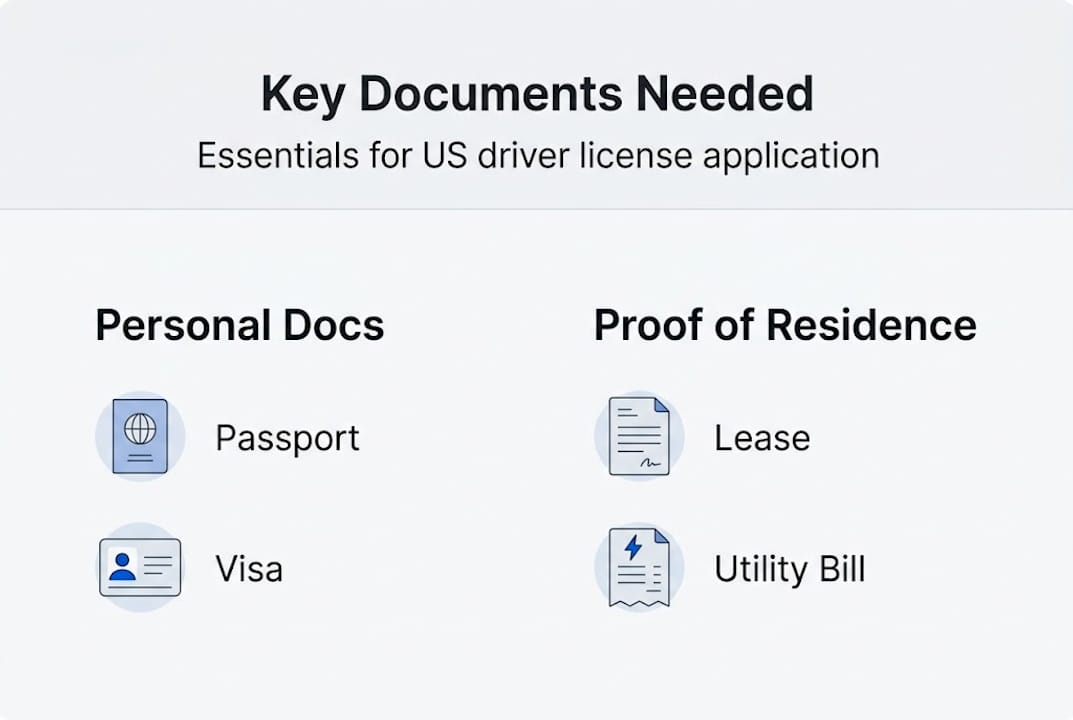
Note that some states have additional requirements, especially for immigrants on certain visa types. California, New York, and Texas each have their own specific rules.
Pro Tip: Bring original documents and at least one photocopy of each. Some DMV offices will not accept expired documents, even if your immigration status is still valid.
Step-by-step process to apply for your first US driver license
With your documents ready, here is exactly how you move through the driver license process from start to finish.
-
Gather your documents and make an appointment. Collect everything from the checklist above. Many DMV offices require or strongly recommend scheduling ahead. Learn more about registering for the DMV exam to avoid long walk-in waits.
-
Complete the application and pay the fee. At the DMV, you fill out a standard application form. Fees vary by state but typically range from $20 to $50 for a first-time license.
-
Take the written exam. This test covers traffic laws, road signs, and safe driving rules. As described in the complete DMV test guide, the application process includes a written exam, vision test, and a driving test. Most states allow you to request the exam in a language other than English, including Russian.
-
Pass the vision test. This is a quick screening to confirm your eyesight meets minimum standards. You can read more about the vision test at DMV to know what to expect.
-
Complete the permit practice period. After passing the written exam, you receive a learner’s permit. Most states require a mandatory practice period of 30 to 180 days before you can schedule your road test.
-
Schedule and pass the driving test. A DMV examiner rides with you and evaluates your ability to handle real traffic situations. Arrive early, bring your permit, and use a reliable vehicle.
In-person vs. online DMV appointments
| Feature | In-person walk-in | Online appointment |
|---|---|---|
| Wait time | Often 1 to 3 hours | Usually under 30 minutes |
| Availability | Daily during office hours | 24/7 scheduling |
| Convenience | No planning needed | Requires internet access |
| Recommended for | Urgent situations | Most applicants |
Pro Tip: Many states offer the written DMV exam in Russian. Call your local DMV ahead of time and specifically request the Russian-language version so staff can prepare it for your visit.
Studying for the DMV written exam: best practices for Russian-speaking immigrants
Prepared for the application, let’s focus on passing the written exam, which is the first major hurdle most immigrants face.

The written exam is not simply a translation exercise. US traffic laws differ from Russian road rules in important ways. For example, right turns on red lights are generally permitted in the US (unless posted otherwise), and rules around pedestrian crosswalks are strictly enforced. Knowing these differences before test day saves you from costly surprises.
Effective study strategies
- Read your state’s official driver handbook, which is available in Russian in many states.
- Take as many practice tests as possible before your appointment. Research shows that repeated practice testing is one of the most effective study methods.
- Focus extra attention on road signs, since many signs in the US use symbols rather than text.
- Review types of DMV exam questions so you understand the format and how questions are phrased.
- Apply proven DMV exam tips to manage your time and avoid common traps.
As confirmed by Russian DMV preparation resources, study materials available in Russian make preparation significantly more accessible for newcomers. Using materials in your native language reduces cognitive load and helps you focus on the actual content rather than the language itself.
“Treat the DMV written exam like a real test, not a formality. Many experienced drivers from other countries fail on their first attempt simply because they underestimate how different US rules can be.”
For additional written test study strategies, external resources can also supplement your preparation.
Managing test anxiety
Test anxiety is real and common. A few practical steps help:
- Get a full night of sleep before your exam.
- Eat a light meal beforehand.
- Read each question twice before answering.
- Skip difficult questions and return to them at the end.
Pro Tip: If you are unsure about an answer, eliminate the obviously wrong choices first. Most DMV written tests use multiple-choice format, so narrowing your options improves your odds significantly.
After the test: Receiving, renewing, or replacing your US driver license
Once you have passed all the tests, here is what happens next and how to maintain your driving privileges long term.
Receiving your license
After passing your road test, the DMV typically issues a temporary paper license on the spot. Your official plastic card arrives by mail within two to six weeks. Some states now offer a Real ID compliant license, which is required for boarding domestic flights and entering federal buildings starting May 2025.
- Confirm your mailing address with the DMV before leaving the office.
- Keep your temporary paper license with you while driving until the card arrives.
- Check that all information on the card is correct when it arrives.
Renewal timelines and options
As outlined in the full US driver license guide, renewal is required periodically, and many states allow renewal by mail or online. Renewal fees and timelines differ by state.
| Action | Typical timeline | Average cost | Method |
|---|---|---|---|
| License renewal | Every 4 to 8 years | $20 to $40 | Online, mail, or in person |
| License replacement | Within 30 days of loss | $10 to $25 | In person or online |
| Name or address change | As soon as possible | $5 to $20 | In person |
Lost or stolen license
If your license is lost or stolen, act quickly. Contact your local DMV to report it and request a replacement. You may need to bring identification documents again. Review the license renewal or replacement procedures on the official government site for your state’s exact steps.
Special cases for immigrants
If your immigration status changes (for example, you receive a green card after being on a work visa), you may need to update your license. Similarly, a legal name change requires updating your license within a specific timeframe. Check state-by-state DMV nuances to understand how your state handles these updates.
“Do not wait until your license expires to renew it. Many states send renewal reminders by mail, but if you have recently moved, you may miss the notice entirely.”
What Russian immigrants wish they knew before starting the US driver license process
The official instructions cover the steps, but they rarely prepare you for the cultural and practical surprises that catch most newcomers off guard.
One of the most common shocks is how strictly examiners follow the test route and evaluation criteria. In Russia, driving examiners sometimes allow flexibility. In the US, a single missed shoulder check or a rolling stop can mean an automatic failure. This is not a judgment call. It is a checklist.
Another frequent mistake is treating the written exam as easy because you have years of driving experience. Many immigrants with 10 or 20 years behind the wheel fail the written test on their first try. US road rules, right-of-way laws, and speed limit logic are genuinely different. Experience from another country does not transfer automatically.
Realistic expectations matter. Getting licensed takes weeks, sometimes months, especially with mandatory permit periods. Planning ahead and using insider DMV exam advice from people who have been through the process makes a measurable difference. Community forums, Russian-speaking driving schools, and native-language resources are not a shortcut. They are a genuine advantage.
Get extra help for Russian-speaking immigrants
Navigating the US driver license process is much easier when you have resources built specifically for you.
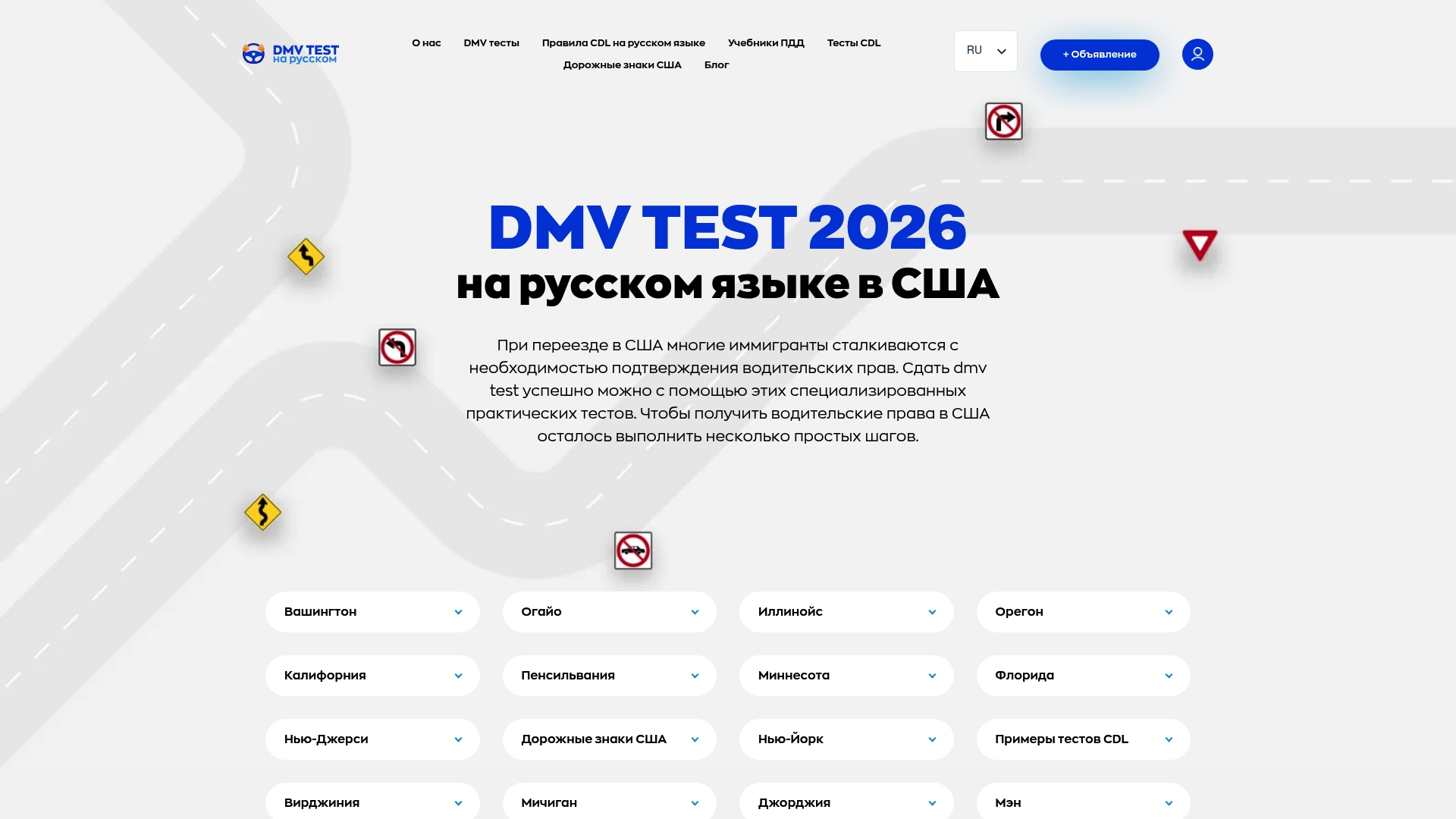
Russian DMV test practice on russiandmvtests.com offers practice tests, road sign guides, and state-specific study materials, all available in Russian. Whether you are preparing for the written exam for the first time or need help with renewal paperwork, the platform covers every stage. The preparation for immigrants section is especially useful for newcomers who want a structured study plan. You can also use the DMV test registration guide to understand exactly how to book your appointment without confusion. Free resources are available immediately, with a premium plan for expanded practice access.
Frequently asked questions
Can I take the DMV test in Russian?
Yes, many states offer the written DMV test in Russian. Check with your local DMV for language options, and confirm availability when you schedule your appointment. Study materials in Russian are also available to help you prepare.
What documents do I need for a US driver license?
Typically, you need proof of identity, legal immigration status, a Social Security Number, and proof of US residence. As noted in the driver license requirements guide, exact requirements vary by state.
How long does it take to get a driver license after passing the test?
Most states issue a temporary paper license on the day of your test, with the official plastic card mailed within two to six weeks. Confirm your address with the DMV before leaving the office.
Can I renew my driver license online?
In many states, you can renew online or by mail if you meet eligibility requirements. The US driver license guide confirms that many states allow online or mail renewal for qualifying drivers.
Recommended


